Project

DUMBO’s cobblestone streets are among the most recognizable in New York City. They are also working infrastructure, carrying people, vehicles, water, and utilities through a neighborhood whose streets were laid out long before modern demands on the public realm.
Over decades, many of the original stones had been disturbed, removed, or covered with asphalt. Beneath them, aging water and sewer systems needed substantial upgrades. The challenge was to modernize the neighborhood without erasing the historic streetscape that makes it distinctive.
In 2019, New York City began a major reconstruction led by the Department of Design and Construction, with the Departments of Transportation and Environmental Protection. The $108 million project was completed in 2025, restoring 25 blocks of cobblestone streets and converting one additional block from asphalt to cobblestone.
The work required more than repaving. More than 800,000 cobblestones were removed and returned to their original streets. Because residents wanted the historic stones preserved in their original locations, the project team stored them off-site during construction and brought them back to the blocks where they had been found.
The reconstructed streets also received more than 12,000 feet of granite curbs, new sidewalks, 114 ADA-compliant pedestrian ramps, and 8,800 feet of smooth granite bike lanes integrated into the cobblestone surface.
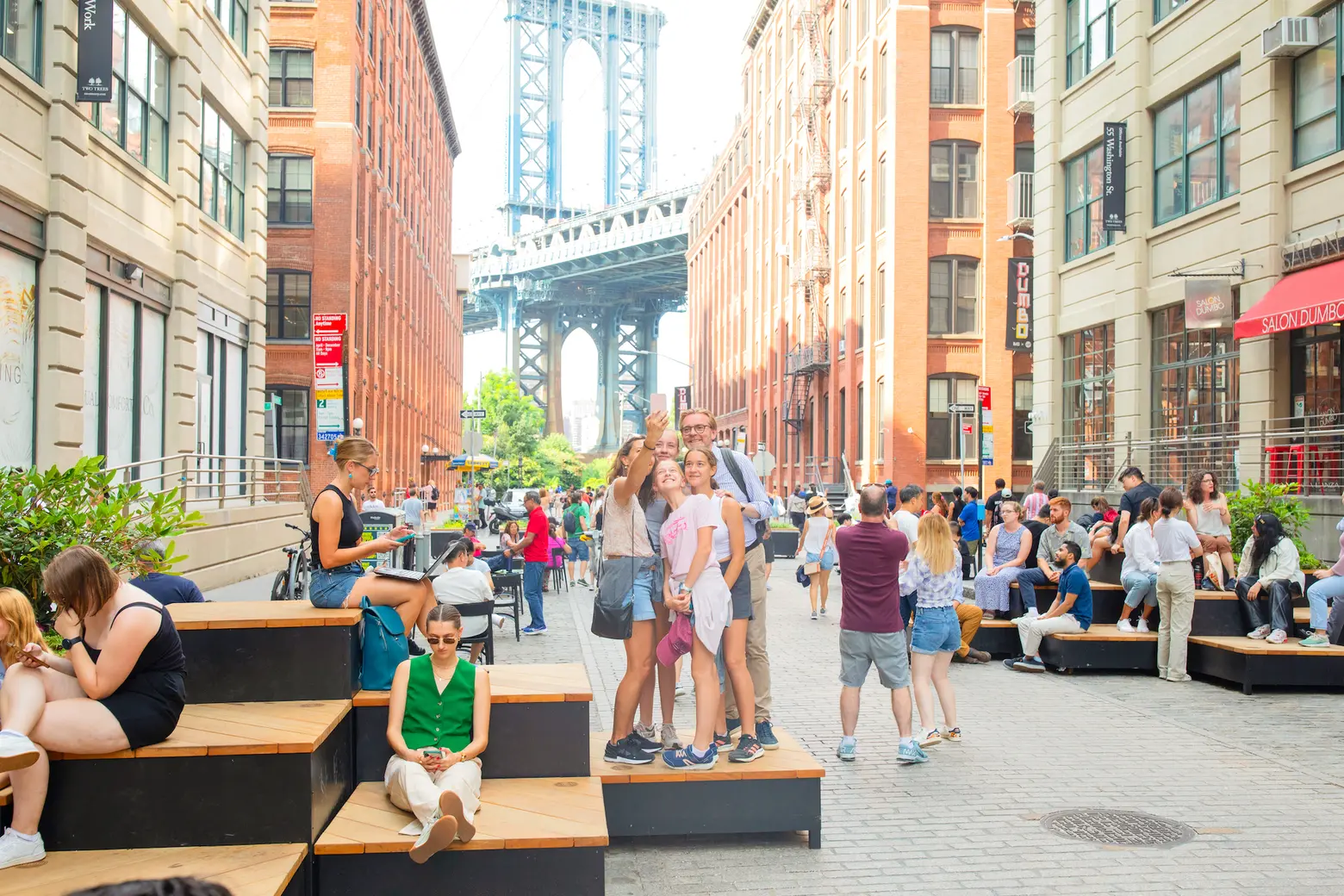
At Pearl Street, the project created a new permanent plaza beside the Manhattan Bridge. The 2,500-square-yard space includes granite paving, seating, planters, umbrellas, and lighting, while the adjoining bridge archway was restored with new illumination.
The result is a substantial piece of city-building that is easy to overlook precisely because it is made up of streets. The historic character remains, but the public realm has been rebuilt to accommodate contemporary movement, accessibility, gathering, and infrastructure needs.
Much of the project’s most important work is invisible from the street.
The reconstruction added 2,735 feet of storm sewers in areas that previously had none, upgraded existing catch basins, and installed 46 new ones. More than 2,100 feet of old combined sewers were converted into dedicated sanitary sewers, while additional sanitary sewers and water mains were replaced or upgraded.
The project also built a new stormwater outfall and removed an outdated combined-sewer outfall and regulator chamber. Together, these changes are intended to reduce sewer backups and the amount of mixed sewage and stormwater entering the harbor during heavy rain.
That underground work explains why the project was more complicated than a streetscape renovation. The city had to coordinate utilities, drainage, historic preservation, accessibility, and construction across narrow streets in an active neighborhood.
The preservation work extended below the pavement as well. Archaeologists worked with the project team during planning and construction, and approximately 2,800 artifacts were uncovered, including ceramics, glass, metal, wood, and other objects dating across several centuries. The discoveries added another layer to the effort to understand and preserve the neighborhood’s history.
The project also shows that preserving historic character does not require preserving every limitation of historic infrastructure. Smooth granite bike lanes and accessible pedestrian ramps were incorporated into streets that retain their cobblestone identity. Pearl Street Plaza creates a new public gathering space within the same historic setting.
The completed reconstruction is not a new neighborhood, but it is a significant act of building within an existing one. It demonstrates how streets can be renewed as complete pieces of public infrastructure—above and below ground—while retaining the material character that connects a place to its past.
Further reading
Visit source